
Nearly 2/3 of DHS “worst of worst” OR arrests in Portland Metro
EXCLUSIVE — Nearly two thirds of DHS “worst of the worst” arrests in Oregon are tied to the Portland metro
The Department of Homeland Security has publicly described a group of illegal immigrants detained in Oregon as the “worst of the worst,” citing alleged criminal histories to justify heightened federal enforcement. An oceanplot analysis of DHS’s records shows that the Portland metro area accounts for a clear majority of those arrests statewide, placing the region at the center of the agency’s enforcement narrative and the ongoing debate over sanctuary city policies.
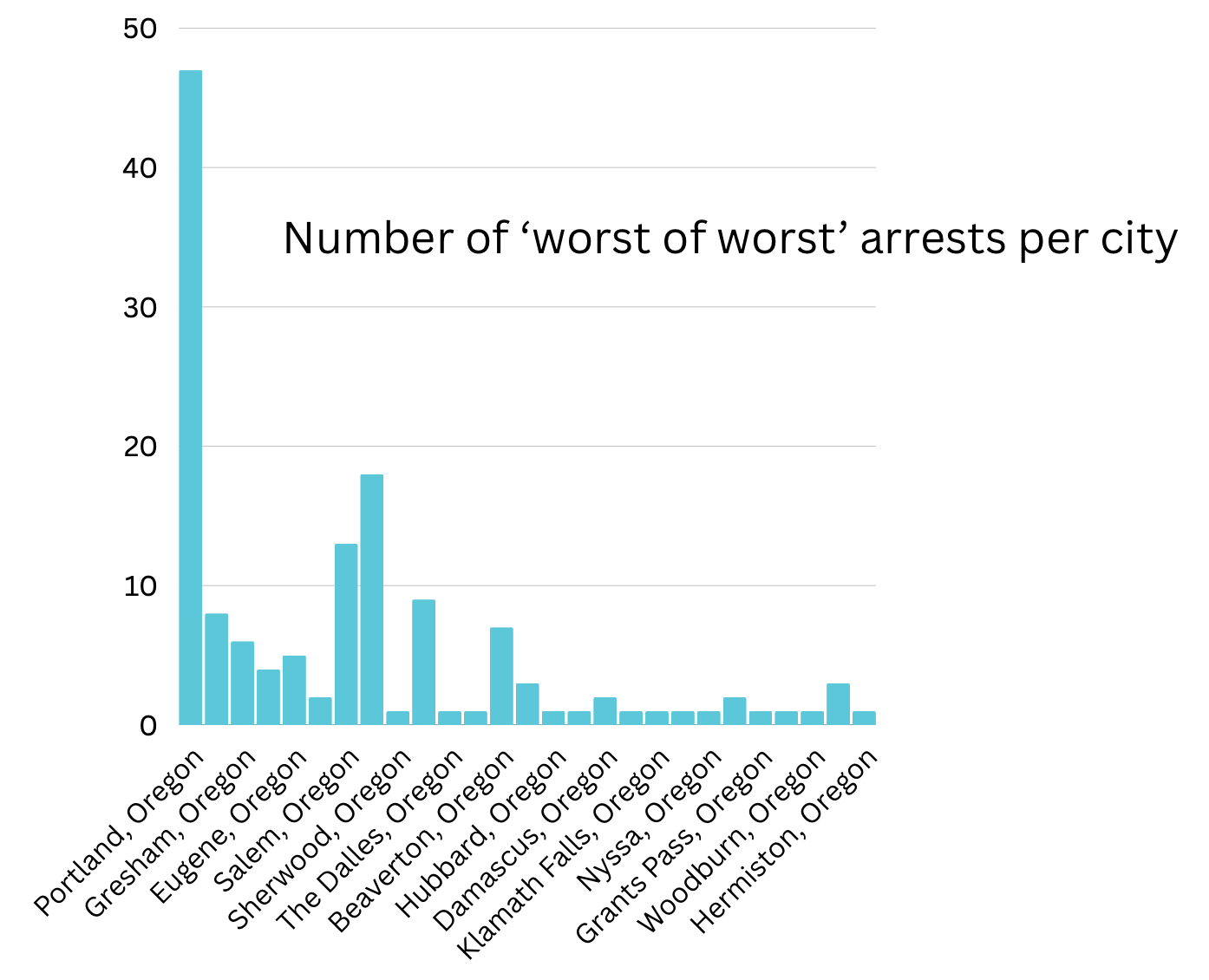
Out of 142 individuals identified by DHS in Oregon, 89 were arrested within the Portland metro area, representing approximately 63% of the entire statewide list. No other region in Oregon approaches that concentration.
Within the metro area, Portland alone accounts for 47 arrests, or about one third of all “worst of the worst” cases statewide, making it the single most common arrest location cited by DHS.
An examination of the alleged crimes listed by DHS across the Portland metro arrests shows a consistent pattern. Assault appears in 24% of metro entries, followed by sex assault at 18%. Broader sex offense classifications appear in 11% of cases. Taken together, more than half of the metro entries involve allegations of assault or sexual violence.
Property, drug, and weapons offenses are also prominent. Burglary appears in 10% of metro cases, while weapon offenses appear in 9%. Allegations involving dangerous drugs, synthetic narcotic sales, and drug trafficking each appear in high single-digit percentages across the metro region.
The most severe violent crimes are also represented. Homicide appears in roughly 6% of metro entries, while manslaughter, robbery, and various rape classifications each appear in approximately four percent of cases. By contrast, immigration-specific charges, such as illegal re-entry or alien smuggling, appear less frequently than violent, sexual, and drug-related offenses in the metro subset.
Taken together, the figures support two conclusions that exist in tension with one another.
First, they show that sanctuary policies do not prevent immigration enforcement. DHS was able to identify, catalog, and publicize these cases, many of them originating in Portland and the surrounding metro area.
Second, and more paradoxically, the data highlights who sanctuary policies are being invoked to protect. The individuals DHS labels as the “worst of the worst” are not defined by immigration violations alone. Many are associated with alleged assaults, sexual violence, drug trafficking, and homicide. Yet these cases are concentrated in jurisdictions where local leaders, including the mayor and city councilors, have argued that federal immigration enforcement should not operate.
The question raised by DHS’s own list is straightforward. If federal immigration enforcement is unwelcome in Portland, how are local leaders accounting for DHS’s own claim that many of the individuals on this list are associated with serious violent and predatory crimes?