Someone in Portland’s Hollywood District has a message for Rapid Response Bio Clean. Written across a garbage can, the words are difficult to miss: KILL RAPID RESPONSE.
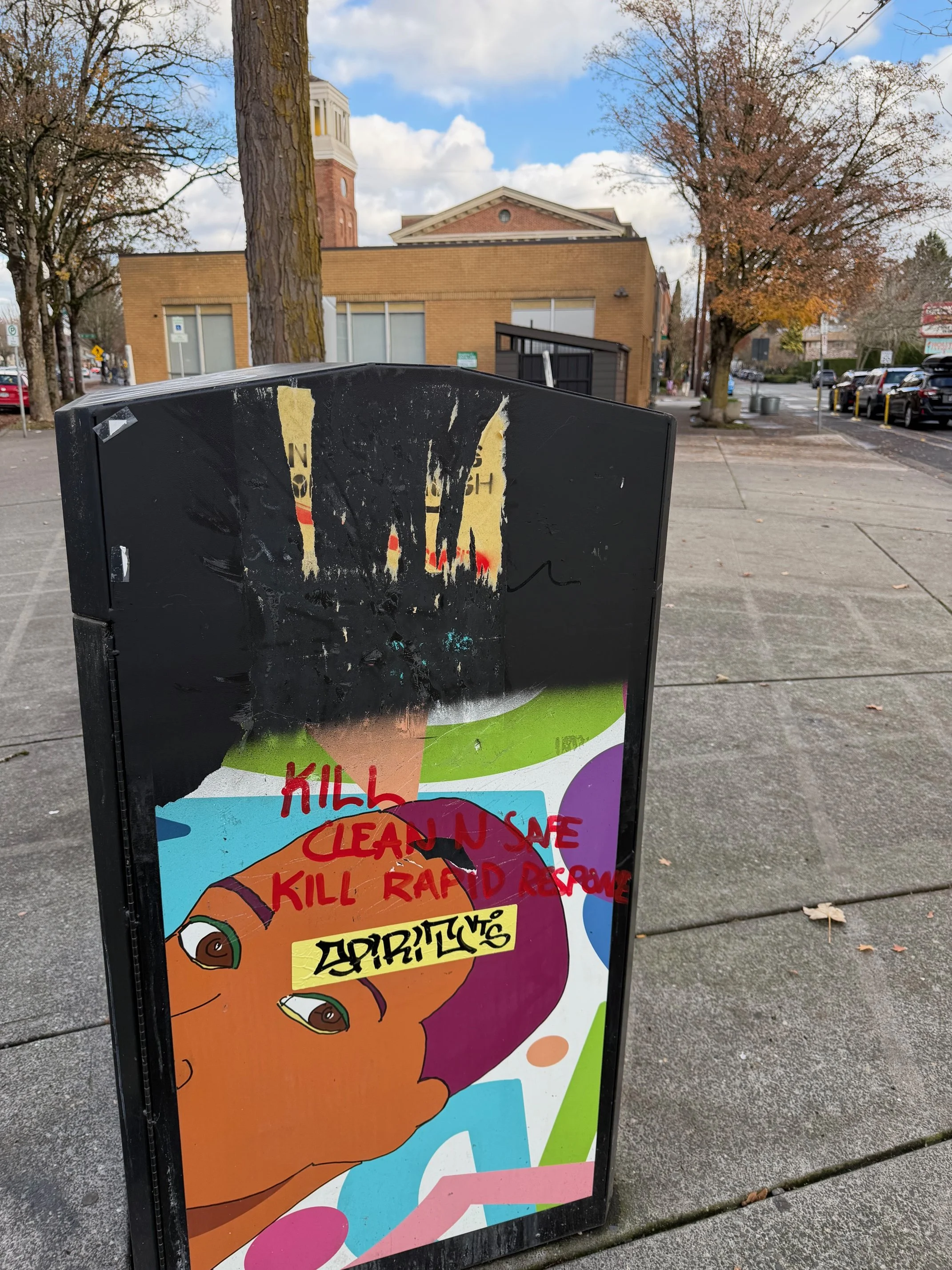
It’s a blunt expression of the hostility that has come to surround Portland’s encampment cleanup operations. The company, a private contractor hired by the City of Portland, has become a familiar and frequently criticized presence in the city’s ongoing efforts to remove homeless camps.
But the people who show up to do the work aren’t the ones who designed Portland’s homelessness policy. They’re the people sent into the field to carry it out.
And sometimes, their work is dangerous.
A job with consequences
On November 17, 2026, a Rapid Response employee was stabbed while working to clean up an encampment near Southeast Water Avenue and Southeast Belmont Street, beneath the Morrison Bridge.
According to court documents, workers had just begun cleaning the campsite when a man allegedly became confrontational, attempted to slash a tire on their truck, and then attacked one of the employees with a knife. The worker suffered a cut to his finger. The suspect, Randall Jonathan Hartwell, was arrested and faces multiple charges.
In October of 2026, Rapid Response crews discovered human remains at two separate encampment cleanup sites within a week of one another.
These are the circumstances in which Portland’s cleanup operates: encounters with people experiencing homelessness, substance-use disorders, acute psychological issues, open drug paraphernalia, hazardous materials, and occasionally scenes involving death or violence.
But there’s an important human dimension to this work that tends to disappear from the public debate.
Who are the people doing it?
What does it take to show up every day? And what does the city consider adequate compensation for that responsibility?
The answer starts with a number: $19.50 per hour.
But first, it’s worth understanding the operation behind it.
A multi-million dollar operation
Rapid Response Bio Clean is a private, for-profit hazardous-waste removal company contracted by Portland to perform campsite cleanup and impact-reduction services.
The company’s relationship with the city has been examined before.
In May 2024, Street Roots published an investigation documenting complaints from former employees and homeless Portlanders about the company’s practices, training, and treatment of personal belongings during encampment removals.
The investigation reported that the city’s contract carried a maximum value of $38.6 million over seven years. Portland had paid the company more than $9.6 million in fiscal year 2022–23 alone.
The city’s October 2026 active-contract report subsequently listed a $50.603 million contract amount for Rapid Response—a difference of nearly $20 million.
Denver, a city with approximately 1.17 times Portland's population, reported spending roughly $55 million on homelessness initiatives in 2025.
Portland’s Rapid Response figure is an authorized contract amount, not a confirmed total of payments received. Nevertheless, it provides an indication of the scale of this operation.
And the work itself is not simply picking up trash.
Portland’s campsite cleanups involve multiple city agencies in coordination, including the Impact Reduction Program, Portland Police Bureau, Portland Solutions and Rapid Response. Some operations involve advance notice; emergency abatements can occur under different circumstances.
Job advertisements from Rapid Response describe field technicians, environmental-services workers, and driver technicians. Some positions involve property cleanouts and general cleanup; others explicitly describe municipal encampment and biohazard remediation.
The advertised responsibilities include handling, packaging and disposing of hazardous materials, working outdoors, operating as part of a field crew, and interacting with vulnerable members of the public.
The number
An October 2026 advertisement for a full-time Driver/Cleaning Technician position at Rapid Response listed compensation at $19.50 an hour.
That’s $780 for a 40-hour workweek, or annualized at $40,560. Before taxes.
However, some of the job posts reviewed for this report were part-time, limiting both the employee’s hours and benefits.
Portland’s metropolitan minimum wage for July 2026 through June 2027 is $16.80, making the advertised starting wage $2.70 above the minimum.
Meanwhile, MIT’s Living Wage Calculator estimates that a single adult without children in Multnomah County needs approximately $27.91 an hour to meet its calculated basic living expenses in Portland.
The advertised starting wage is approximately 30% below that estimate, which raises another question: are the people tasked with clearing Portland’s encampments themselves economically vulnerable?
The people responsible for addressing one of Portland’s most visible social crises may themselves be at risk of housing insecurity.
And this is where the question becomes more complicated than a simple comparison of economics.
Portland's own wage policy
In addition to a citywide minimum wage, in May 2025, Portland City Council passed Ordinance 192054, reestablishing a Fair Wage Policy under Chapter 5.70 of the Portland City Code.
The policy establishes minimum hourly compensation requirements for employees performing certain services under city contracts.
Those covered services are specifically defined as janitorial services, security services, and parking garage attendant services.
For fiscal year 2026–27, the city’s recommended minimum fair wage for covered services is $20.89 an hour. That’s $1.39 more than the advertised starting wage at Rapid Response.
But the ordinance doesn’t apply to every city contractor. Whether Rapid Response’s campsite-removal and biohazard-remediation work falls within one of the covered classifications has not been independently established; with full-time and part-time job advertised below the rate, it appears the city has created a wage-protection framework that filters out those performing camp cleanup.
The cost of compassion
There is a particular expectation built into this work.
Workers are expected to interact with people who may be experiencing addiction, psychological distress, homelessness, trauma, or some combination of these circumstances.
They must perform their assigned duties while navigating unpredictable behavior, potentially dangerous environments, and the emotional consequences of what they encounter.
They may encounter people who are frightened, angry, intoxicated, disoriented, or unwilling to leave the places they have come to call home. They may encounter people who are simply trying to survive, are confused, or have no place to go.
This work requires a degree of patience and restraint. It requires following procedures, maintaining safety, managing conflict and treating people with dignity, even when an encounter becomes difficult.
But there's an enormous cost to that expectation, and it isn't reflected in the advertised wages.
We talk frequently about the human cost of homelessness. But there’s another group of people who experience the consequences of the crisis as part of their daily employment.
What does repeated exposure to these circumstances do to a person? What kind of support is available after a violent encounter? What happens when a worker begins to dread going to work?
Or sees it in their dreams?
The people behind the cleanup
Do you currently work for Rapid Response Bio Clean, Clean n Safe, or the City of Portland? Do you know someone who does?
I want to hear about the actual experience of doing this work. I’m interested in wages, working conditions, training, safety, management, the emotional toll of repeated exposure to difficult circumstances, and what happens after an employee experiences a traumatic incident.
If you have a story to tell—reach out to me.
Rapid Response Bio-Clean and The City of Portland were contacted for this story. No response was received by publication time.